Bec Wiley didn’t just learn a trade – she carved out history.
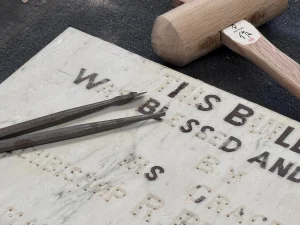
As the first woman in Australia to complete the Group A Heritage Specialist apprenticeship in stonemasonry, she has broken new ground in a field defined by tradition. Earlier this year, Bec officially earned the certification, which demands additional study of the Burra Charter, the framework for preserving historic sites.
Breaking the Mould
Stonemasonry, especially the heritage-focused field Bec now excels in, is a traditionally male-dominated industry, and her path into the trade wasn’t typical. For twelve years, Bec worked in administration, first in community services and later as a property manager at Access Housing. “I finished at Access Housing in policy and procedure writing,” she explains. But when her company merged, the redundancy offer seemed like an opportunity for change. “I was like, ‘Thank you very much. I will take that.’ My son was still young, so I decided to take a year off.”
Though her background wasn’t in construction, she had always enjoyed practical work, particularly woodwork. “I used to do woodwork at home. I was like, ‘Oh yeah, maybe I can do that. I’ve always been fairly handy,’” she reflects. She applied for a carpentry apprenticeship, but Jo from Colgan offered another suggestion. “She took my application but also said, ‘We also have a stonemasonry apprenticeship.’ I literally YouTubed it and thought, ‘Oh, I like that! I can see myself doing that.’”
Without much thought to the fact that there weren’t many women in the field, she applied. After an interview with James, Daniel and Nathan, she convinced them to take a chance on her. “They were probably a little bit terrified and sceptical, but they did, and so I began. And I loved it – I’ve loved it ever since. It’s hard, but it’s incredible.”
Navigating a Male-Dominated Field
Bec is keenly aware of the challenges women face in the construction industry. While she considers herself fortunate to work with a team of supportive and respectful colleagues, she acknowledges that not all women in the industry have the same experience.
“I’m probably incredibly lucky. I work with an amazing group of just wholesome, humble, generous, kind men.” She also credits her age and confidence for helping her navigate the workplace. “It helps that I’m older, and I’ve got a thicker skin.”
At the same time, she understands why many women hesitate to enter the field. “I hear a lot about sexual harassment, and I know it can be incredibly intimidating and difficult,” she says. “There was one girl at TAFE who started, and she dropped out because of that sort of thing, which is just such a shame.”
Bec believes fear of harassment prevents many women from even considering a career in stonemasonry. “I think a lot of women and girls are probably scared. And that makes me sad,” she says. “Yes, something could happen, and that would be atrocious. But what if it doesn’t? What have you missed out on? You have to try.”
She also learned to interpret the lack of feedback: “What men are not very good at is giving feedback or validation, so you quickly have to figure out, okay, well, no one’s actually telling me I’m doing a good job. But if they don’t come back and redo what I’ve done, I think it’s okay.”
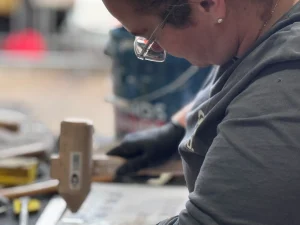
On the physical demands of the job, Bec says, “It is intense, and the muscle fatigue is huge.” She acknowledges the physical strain but also emphasises the importance of asking for help when needed. “There is common sense, and I don’t feel bad about going, ‘I can’t lift that. Can someone give me a hand?’” Despite the exhaustion, she notes, “It’s a good wholesome, kind of exhausting.”
Why Aren’t There More Women in Stonemasonry?
Bec believes fear and misconceptions play a major role in why so few women pursue stonemasonry. Many, she says, are hesitant to even try, worried about the challenges they might face. While those concerns are valid, she finds it frustrating that they can deter women before they’ve had a chance to experience the trade for themselves.
Beyond that, she highlights the complexity of the work, which blends physical labour with artistry. “With stonemasonry, there is that really physical, laborious side of it, but then there’s the artistic side, which I also love. You just have to be willing to do a bit of everything. And if you don’t give it a go, you’ll never know.”
Finding the right apprenticeship is another hurdle, particularly for young women straight out of school. “It’s difficult – you have to find the right people,” she says, noting that the industry’s structure can make it hard to break in.
She also emphasises that flexibility is essential for women in stonemasonry and construction, yet often lacking. As a parent, she juggles caring for her children, including taking half the school holidays off, which adds up to significant time away from work. Beyond childcare, Bec points out that women face other physical realities that men don’t have to think about. “If Colgan’s weren’t as incredibly flexible and understanding, it would not be possible at all,” she says.
Bec also points out that opportunities for traditional stonemasonry vary by location. Western Australia, for example, has fewer dedicated heritage stonemasonry teams compared to places like Sydney. This limited demand can make it even harder for newcomers to find the right path. She also acknowledges that public perception of the trade has narrowed, with much of the conversation focused on benchtop manufacturing and the risks of silicosis. While these are important issues, she stresses that stonemasonry is far more than that, encompassing conservation, restoration and skilled craftsmanship that often goes unnoticed.
Mentorship & Support
Bec credits much of her success to the mentorship and support she received at TAFE and Colgan’s, saying she was fortunate to learn from “the two most talented stonemason teachers in all of Australia – definitely the best I know of in Western Australia.” Those teachers were James Mason, one of her direct supervisors at Colgan’s, and Kenneth Cooper, her TAFE lecturer, both of whom, she says, have “such a rich knowledge of the trade, of all aspects.”
She sees herself returning to TAFE as a lecturer one day, recognising the need for skilled professionals who can master every facet of the craft. “There just aren’t that many stonemasons that can do the whole kit and caboodle, which is the benchtops, but the random rubber walls, the letter cutting, the carving, sculpture – all of that sort of stuff,” she says. “And they just do. They both have it.”
Having James as both a supervisor and teacher was a unique advantage. “To have James at Colgan’s, to be so saturated at work and at TAFE, was incredible,” she reflects, adding that she was also Ken’s last full-time student. She describes James’s teaching style as hands-on and challenging. “James is from England originally, so he has all of that old-school kind of knowledge, and he just throws me in the deep end and then goes away, and then I’m just sitting there,” she says. “But he does it in such a way that I do figure it out. He’ll just show you something and you’re like, oh, and his hand skills are incredible. I’m just really lucky to have
two great teachers.”
Carving A Legacy
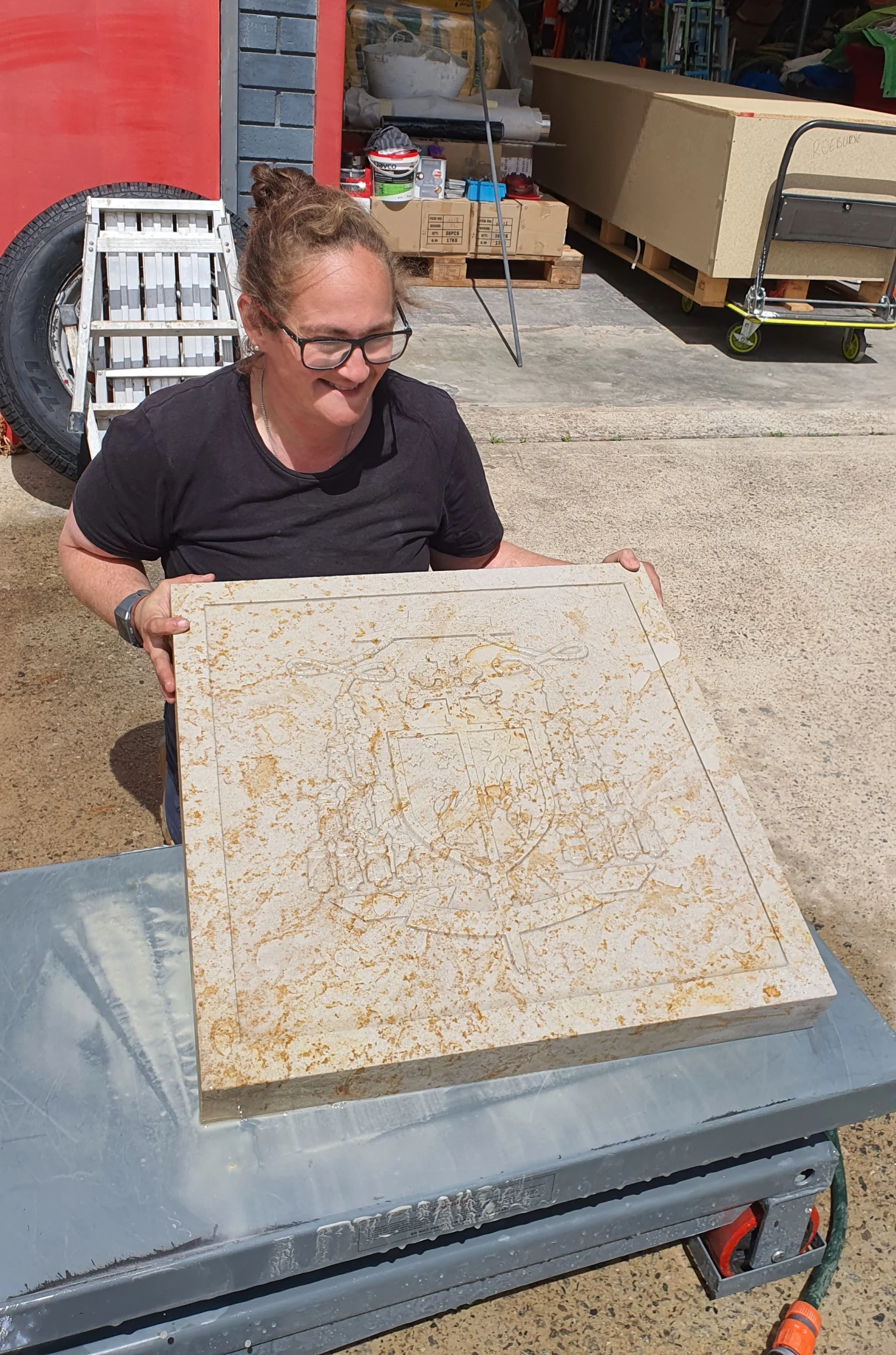
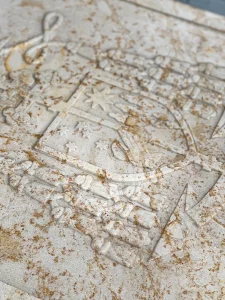
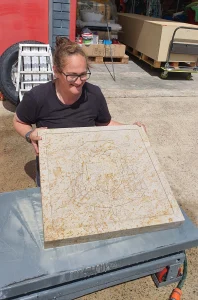
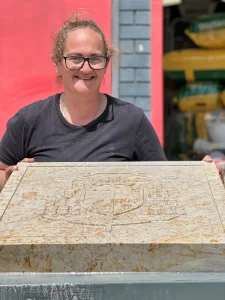
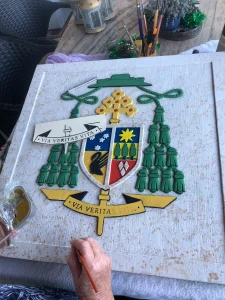
Bec’s first stone project with Colgan was carving the Archbishop’s crest at St. Mary’s Cathedral. “It was this massive crest on a huge piece of Donnybrook stone,” she says. Back then, she was still pretty new to the trade, and James decided to give her a chance to create a clay maquette first. “I spent a couple of weeks working with a slab of clay,” Bec says. It was a great introduction to how stone would behave and how curves and hollows should be worked. She thought she was just getting practice in, but then James turned around one day and said, “Actually, you’re doing the real one now.” It was a pivotal experience for Bec, though she admits, “I had many moments where I thought I’d broken it or buggered it up.”
The project itself took her six weeks to complete, but when it was finished, it was stunning. “I love chisels, and I love chiselling things,” Bec says, and this piece, made from a unique white Donnybrook stone with striking iron veins, was one she’ll never forget. Once she’d finished carving, Dot Colgan – Martin and Dot Colgan founded Colgan Industries – painted the crest, and then Bec got to install it herself. “That felt pretty cool,” she adds.
A Niche Specialisation
In Western Australia, limestone walls are a defining feature, especially in historic areas like Fremantle. But as Bec points out, “20, 30 years ago, the best practice was probably to cover everything in cement.” At the time, it seemed like a good idea, but the issue was that cement doesn’t allow stone to breathe. “What’s happened is a lot of this limestone has broken down because it’s not being allowed to flex or breathe through the cement.” This is where the restoration process begins: carefully chipping away the cement to reveal the limestone or lime render beneath, allowing it to breathe and move again.
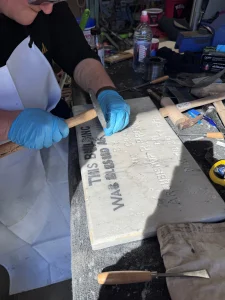
Bec’s first job as an apprentice with Colgan involved this very technique on the Supreme Court’s façade. “I spent months honing three millimetres of cement off lime-rendered walls,” she recalls. While the task was monotonous and repetitive, the setting was anything but. “I was on top of the Supreme Court of Western Australia, so it was pretty cool,” she adds with a grin. The job required great attention to detail, especially when it came to fixing cracks. “Every crack that was three millimetres or bigger, we had to fix,” she explains. After months of chiselling away the cement, they applied a lime wash, which, by the end, took about four to five months. Of course, they had to work around court sessions. “You could only hone for a certain period of the day because then court was in session!” she laughs.
Restoration isn’t just about technique, though – it’s about using the right tools. In her studies, Bec learned the importance of gentle methods, especially when it came to washing the stone. “You never take a steel brush to stonework,” she says, explaining how tiny fragments can rust and leave marks. “Gentle steam washing, no high pressure, or you end up taking the patina off,” she adds. Through these meticulous, time-consuming techniques, Bec has come to appreciate the delicate balance required in heritage restoration and the wisdom that comes with understanding what the stone needs to breathe and live again.
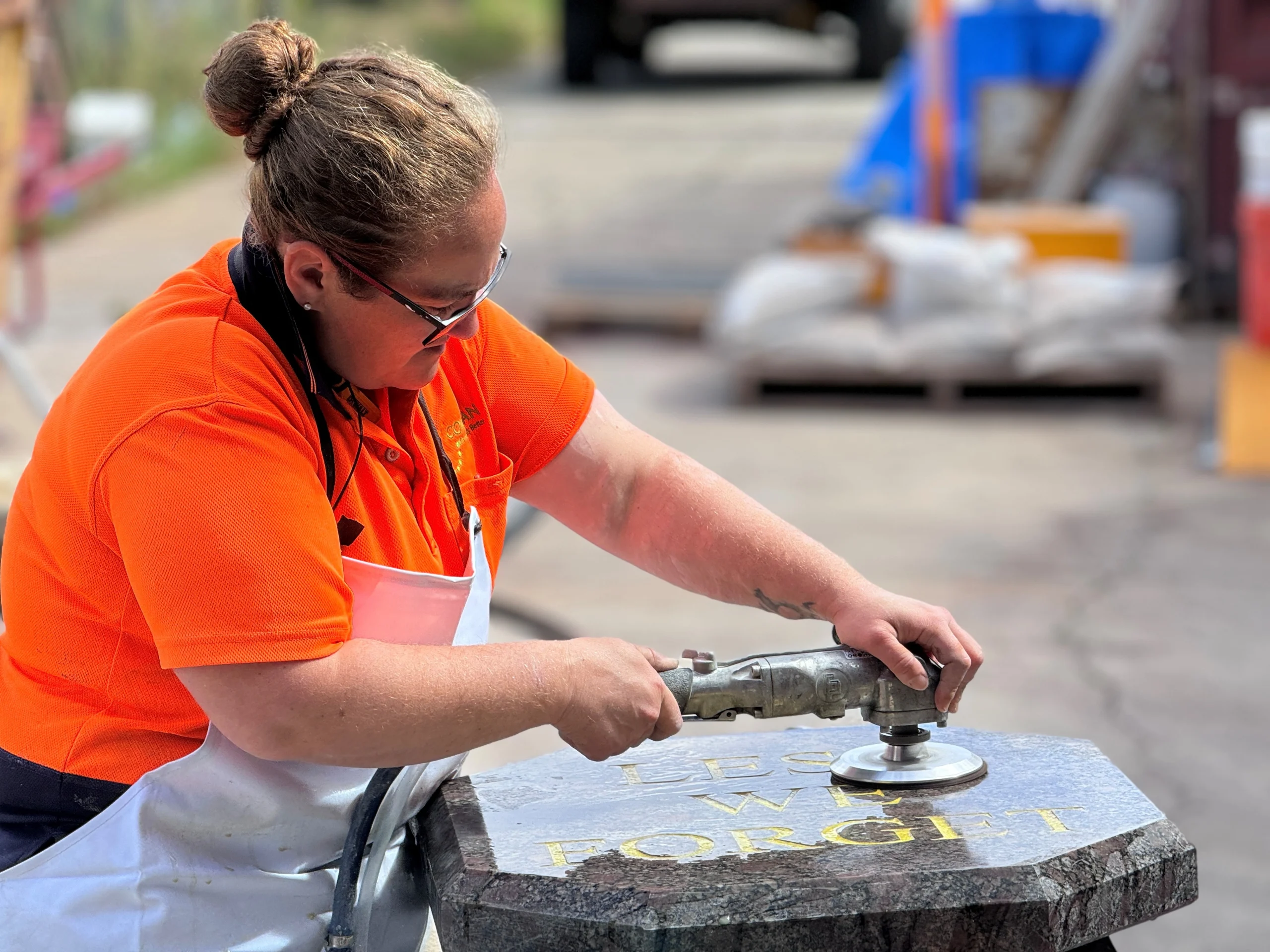
Bec’s passion for stone carving comes alive in her approach to free carving, a technique that allows her creative instincts to flow without the constraints of the precise, regimented nature of traditional stonemasonry. “I love free carving,” she says, recalling the two final projects she had at TAFE—one of which was a flora and fauna piece in recess carving. But, in typical Bec fashion, she pushed the boundaries. “I said to Ken, ‘Ken, can we extend that to a human?’ I literally just wanted to carve a bust,” she recalls with a grin. The result was a clay maquette of a bust that she worked on during the COVID lockdown. “It was based on an ex from the time,” she notes, laughing at the thought of the finished piece, “but of course, it had nothing to do with them.” It was a liberating experience, she explains, a welcome departure from the rigid discipline of traditional masonry.
The Future of Stone
Bec acknowledges that stonemasonry, particularly the art of it, often finds itself overshadowed by the more commercialised side of the industry, especially the booming benchtop market. “The work and art of stonemasonry has been really overshadowed by the focus on the benchtop industry and silicosis,” she notes. Silicosis, a serious concern in the trade, has understandably garnered attention. “It’s extremely valid because silicosis is very scary, a very real, and huge reality,” she adds with gravity.
However, she believes there’s a way to practice the trade safely and responsibly, even when working with high-silica materials like Donnybrook stone. “There is a way to enjoy the trade and be safe,” she explains. “People just don’t know what it’s all about.” It’s this gap in awareness that Bec sees as a challenge for the industry.
As Bec reflects on the future of her career in heritage restoration, she remains open to wherever Colgan’s path might lead her. “I don’t know. I have to see where Colgan takes me,” she says, but there’s no doubt that, among Perth’s many companies, Colgan is where she feels most at home. “If I’m working in this field, specifically in heritage restoration, Colgan is who I want to be with because they specialise in it, and we are the best at it.”The sense of belonging runs deep within the company. “Colgan is a family,” Bec explains, and the work she and her colleagues produce – whether it’s on Government House or Fremantle Prison – is a testament to the pride they take in their craft.
Looking ahead, she dreams of taking on even bigger projects. “I’d love to have my own building, like Fremantle Prison or one of those buildings, as my baby one day.” She envisions herself overseeing the restoration, watching it evolve over time and managing its care. With her background in asset management, Bec’s ability to think strategically about the long-term care of buildings adds a unique dimension to her work. “I find myself doing that when we start on a building,” she says, “I look at it and think, ‘Where is it going to go?’”
Her ambitions extend beyond Perth as well. “I’d love to go overseas one day,” Bec says. “If there was a workshop in England, or in Rome, for a restoration project, I’d be like, ‘Yes, yes, I’m available. Thank you.’” The world, it seems, is waiting for her to leave her mark on it.