STATE HERITAGE

Government House was completed in 1863, built for approximately £15,000 — just over twice its planned budget. As with an earlier Vice Regal residence completed for Governor James Stirling in 1835, the project was stymied by the lack of skilled craftsman in the colony, resulting in works mostly being completed by convicts.

THE BALLROOM

A banqueting hall was constructed on the current Ballroom site in anticipation of a visit by Prince Alfred in 1869. Various design updates were proposed over the years following, until the existing design was completed in 1899.

ALMOST LOST
TO HISTORY

Economic depression followed by post-war urban renewal almost resulted in the destruction of Government House. In 1989, architect Mr Ron Bodycoat’s Conservation Plan set the course for a series of restoration and refurbishment projects in the House and Grounds.

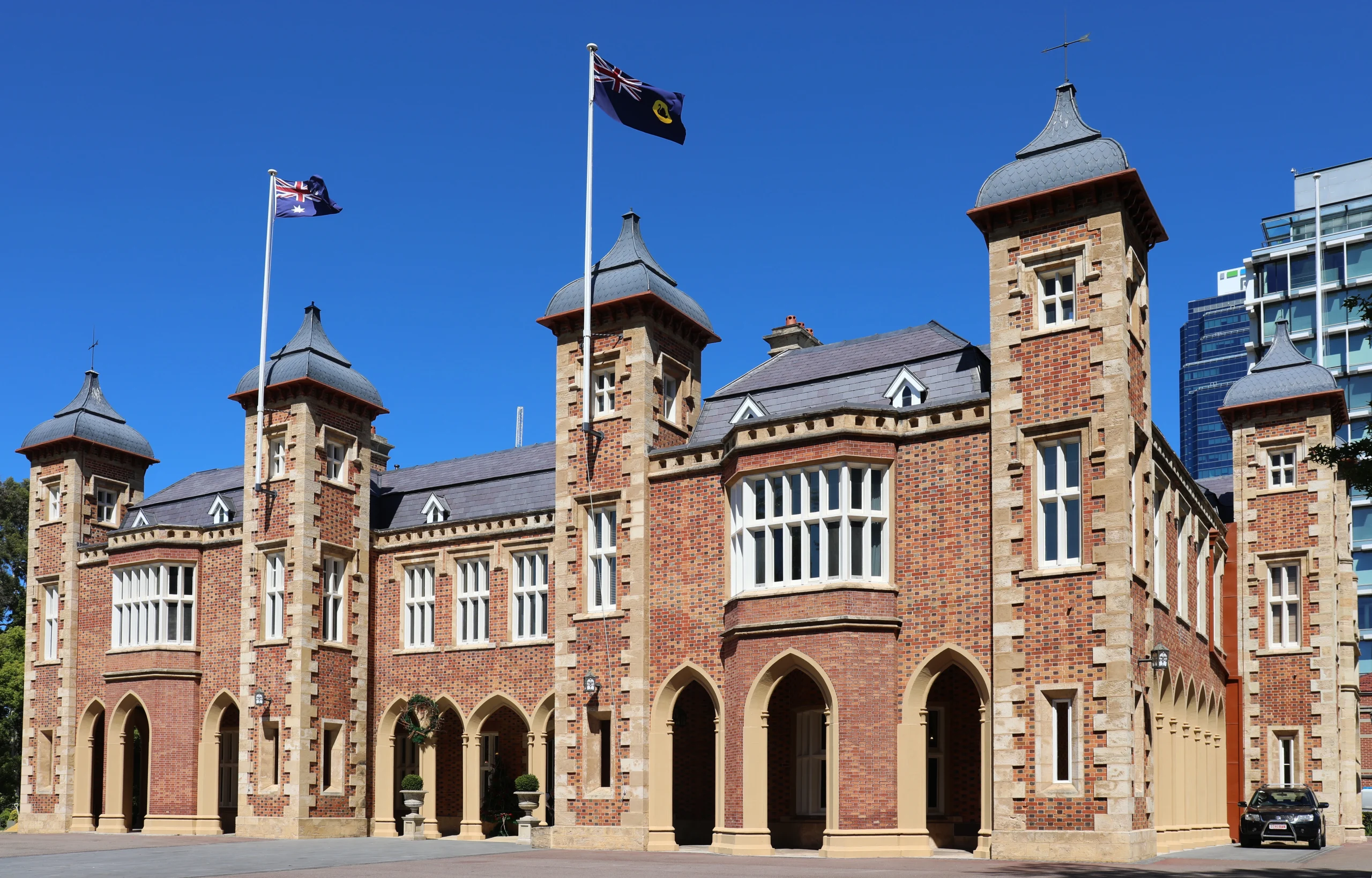
While following Jacobean archetypes, the unique architectural character mixes Gothic and Victorian Revival. Note the stonework and bonded brickwork, incorporating square mullioned windows, decorated gables and ogival capped turrets.

While following Jacobean archetypes, the unique architectural character mixes Gothic and Victorian Revival. Note the stonework and bonded brickwork, incorporating square mullioned windows, decorated gables and ogival capped turrets.

While following Jacobean archetypes, the unique architectural character mixes Gothic and Victorian Revival. Note the stonework and bonded brickwork, incorporating square mullioned windows, decorated gables and ogival capped turrets.

Government House, Ballroom and its Gardens are classified by the National Trust.

1 / 5
Image-Government House-259
Image-Government House-848
The foundation stone was laid 17 March 1859.

STATE HERITAGE

Government House was completed in 1863, built for approximately £15,000 — just over twice its planned budget. As with an earlier Vice Regal residence completed for Governor James Stirling in 1835, the project was stymied by the lack of skilled craftsman in the colony, resulting in works mostly being completed by convicts.

THE BALLROOM

A banqueting hall was constructed on the current Ballroom site in anticipation of a visit by Prince Alfred in 1869. Various design updates were proposed over the years following, until the existing design was completed in 1899.

ALMOST LOST
TO HISTORY

Economic depression followed by post-war urban renewal almost resulted in the destruction of Government House. In 1989, architect Mr Ron Bodycoat’s Conservation Plan set the course for a series of restoration and refurbishment projects in the House and Grounds.

While following Jacobean archetypes, the unique architectural character mixes Gothic and Victorian Revival. Note the stonework and bonded brickwork, incorporating square mullioned windows, decorated gables and ogival capped turrets.

While following Jacobean archetypes, the unique architectural character mixes Gothic and Victorian Revival. Note the stonework and bonded brickwork, incorporating square mullioned windows, decorated gables and ogival capped turrets.

While following Jacobean archetypes, the unique architectural character mixes Gothic and Victorian Revival. Note the stonework and bonded brickwork, incorporating square mullioned windows, decorated gables and ogival capped turrets.

Government House, Ballroom and its Gardens are classified by the National Trust.

Image-Government House-293
Image-Government House-914
The foundation stone was laid 17 March 1859.

THREE DECADES
OF CARE

Colgan has been involved in many restoration, conservation and landscaping projects at Government House over the past 34 years, beginning with Martin Colgan’s work with Ron Bodycoat.
Read more +

Government House is a rich tapestry of quintessentially Western Australian materials, including Donnybrook sandstone, Tamala limestone, marble, basalt and bluestone.

Colgan arranged the installation of a lift and new bathrooms for the royal visit of Queen Elizabeth II for CHOGM in October 2011.
Image-Government House-166
Image-Government House-376
Image-Government House-623
Image-Government House-146
Read more +
Image-Government House-683
Image-Government House-981
Fanny Balbuk Yooreel Sculpture

Created by Joan Walsh-Smith OAM and Charlie Smith OAM, Colgan was honoured to install the sculpture dedicated to Fanny Bulbuk, one of Western Australia’s earliest Aboriginal land rights activists, in the Garden in 2022.

Historian Bob Reece observes that Balbuk was: “the last full-descent woman of Kar’gatta, the Bibbulmun name for the Kings Park area of Perth. Her life story is a compelling snapshot of how life was lived by local people and the impact of white settlement here. Elders describe hers as a story of defiance and determination.”

In the words of Gov. Kim Beasley’s address to the crowd on unveiling of this statue of Balbuk, “Balbuk’s fiery spirit, and her importance as an activist for her people, live on.”