CULTURES CONVERGE
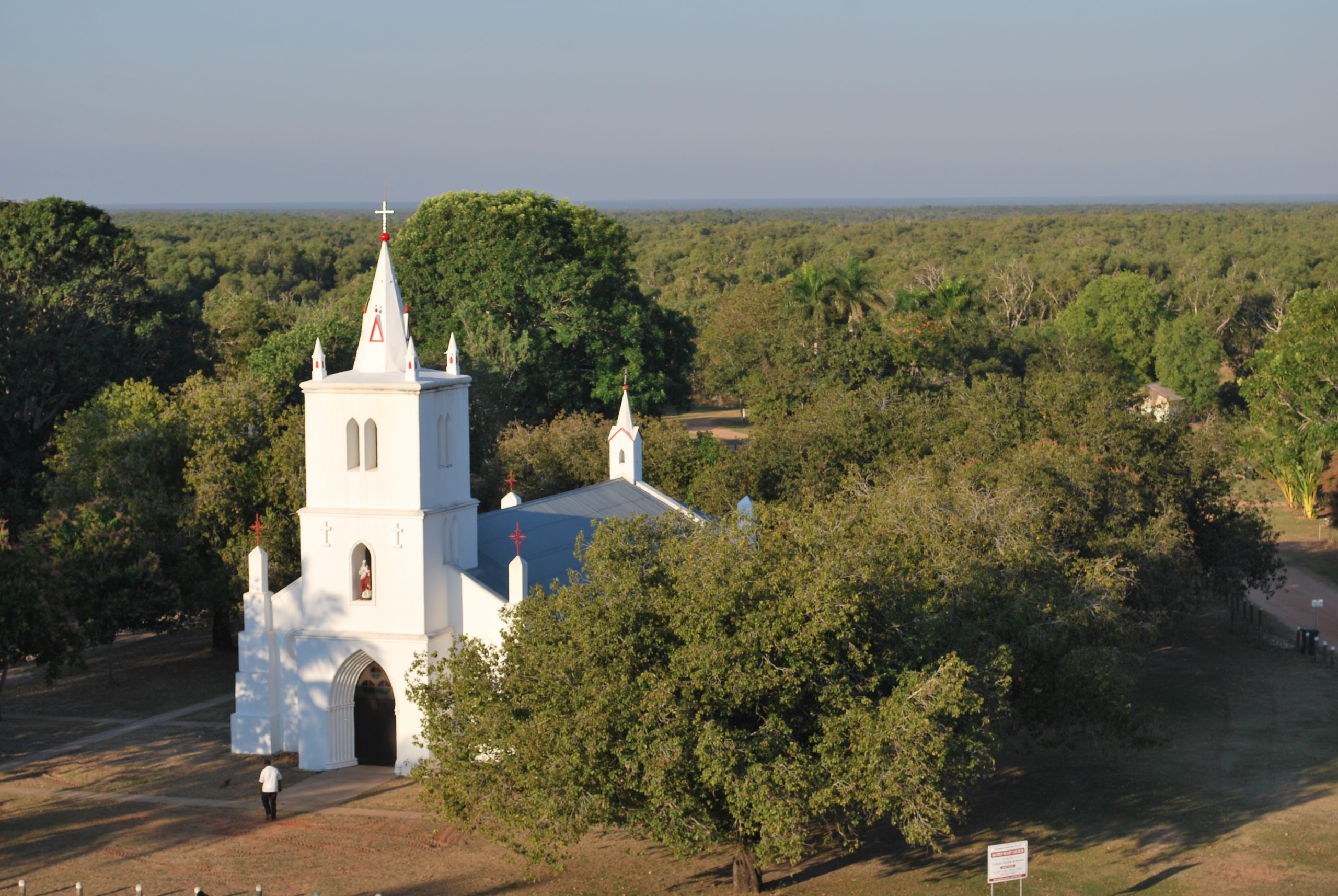
The gleaming white church with famous mother-of-pearl alter, Sacred Heart in Beagle Bay is a remarkable marriage of German and Aboriginal culture. Completed in 1917, it reached international audiences appearing in the 2009 film Bran Nue Dae. While built in the Bavarian-gothic style, the church has an airy, light and uplifting feel, with a rich history in it’s stone and shell walls.
CHANGING ORDERS
French Trappist monks brought Christianity to Beagle Bay in 1890 after a disastrous attempt to found a mission at Disaster Bay. The Trappists were eventually replaced by Pallottine missionaries from Germany and the Sisters of St John of God from Ireland.
WARTIME INGENUITY
When World War I broke out in 1914, Germans in Australia’s north west were arrested and interned at Beagle Bay.
Cyclones, white ants and bush fires had destroyed previous wooden churches. Under house arrest, Father Bachmair pushed for a unique building approach using local materials, modelled on a photograph of a German country parish church.
NATURAL ELEMENTS
An estimated 90,000 clay bricks were handmade and fired on-site, with mortar made from the ashes of burnt shells.
The roof was originally mangrove wood and brush and the ceiling was decorated with shells to represent stars. This was destroyed by termites in the 1920s and was replaced with flattened kerosene tins and later with corrugated iron.
HISTORY AND COMMUNITY
While attracting tourists for its shimmering vernacular style, it remains a working church, and is well-known in the Kimberley as a place where children of the Stolen Generations came to live after they were taken from their families across the region.
Once the building was completed in 1917, a team of Aboriginal women worked under the direction of a German priest to decorate the interior with mother of pearl, cowrie, volute and olive snail shells. They adorn the Stations of the Cross on the churches walls and surrounding the windows, and are also inlaid into the floor.


